
A Letter for Sasha
Notes for A student that apply to MANY students

Greetings from Newark Liberty International Airport! I’m just finishing up an airport dinner before heading off to Europe for the rest of the year (soooo fancy, eh?). Three weeks in London, Munich, and Hamburg are a treat to say the least and I’m very much looking forward to seeing friends and family.
Before I leave, I want to take a minute to write a letter to Sasha. Sasha lives pretty far from my studio and can only make lessons intermittently. This makes it tough to retain lesson information. While my blog contains lots of information that may be helpful, it can be devilishly tricky to know how to tie all of the things together in a meaningful way.
With this in mind, I thought it would be a good idea to leave Sasha with a letter that sums up some of the stuff she already knows and some of the stuff she might want to think about. I’m very much sharing this with her permission, so if you’re one of my students - fear not! - you will never find a surprise letter to YOU!
The Letter
Hi Sasha! It was great seeing you last week and I hope this letter gives you some help. Working long hours with shoulder pain sucks and if you’re not careful you can get a lot of bad advice on how to “fix” your neck and shoulders through physical exercise. I’ll do my best to explain how the Alexander Technique can address this and hopefully give you some help between now and our lesson next month.
In that sense, this letter is NOT intended to be a full documentation of ALL the stuff and things.
Know Your Habit
You have a tendency to push your head forward ever so slightly. I can’t completely recall, but if I remember you also have a tendency to have your chin drift towards your right as if the astigmatism in your weak eye causes you to push one eye further forward than the other. This slight push creates downward pressure on the top of your spine and causes the back of your head to push down onto the back of your neck.
The result of this is a slight straightening of the curve of your neck and a mild twist in the muscle of the neck and voice.
This corkscrew of tension is causing the upper back to brace and the right portion of you upper ribs to ever so slightly press forward. The muscles around the front of the rib cage are therefore tensing up in a particular way and lifting your chest forward and pulling your shoulders and upper arms inward, forward, and down. Whatever you do, PLEASE DONT PANIC!!!
When this pattern of tension occurs in the head, neck, and upper back the lower back, hips, and legs will begin to stiffen. In particular, you will feel limited mobility in the muscles around the spine and excess tension in the quadriceps. All of this will add up to extra pressure in the balls of your feet relative to the heels.
Why Do You Feel Stuck?
Pain is a real jerk. You’ve been noticing some neck tension but a lot of shoulder pain. These sensations have hidden the tension in you chest and mid back. If you recall, at the end of our last lesson I kinda mushed your lower ribs towards the spine in a particular way and you thought that felt good. Your shoulder pain was just blocking you from feeling the tension in your chest muscles.
What Do I Want You to Sense?
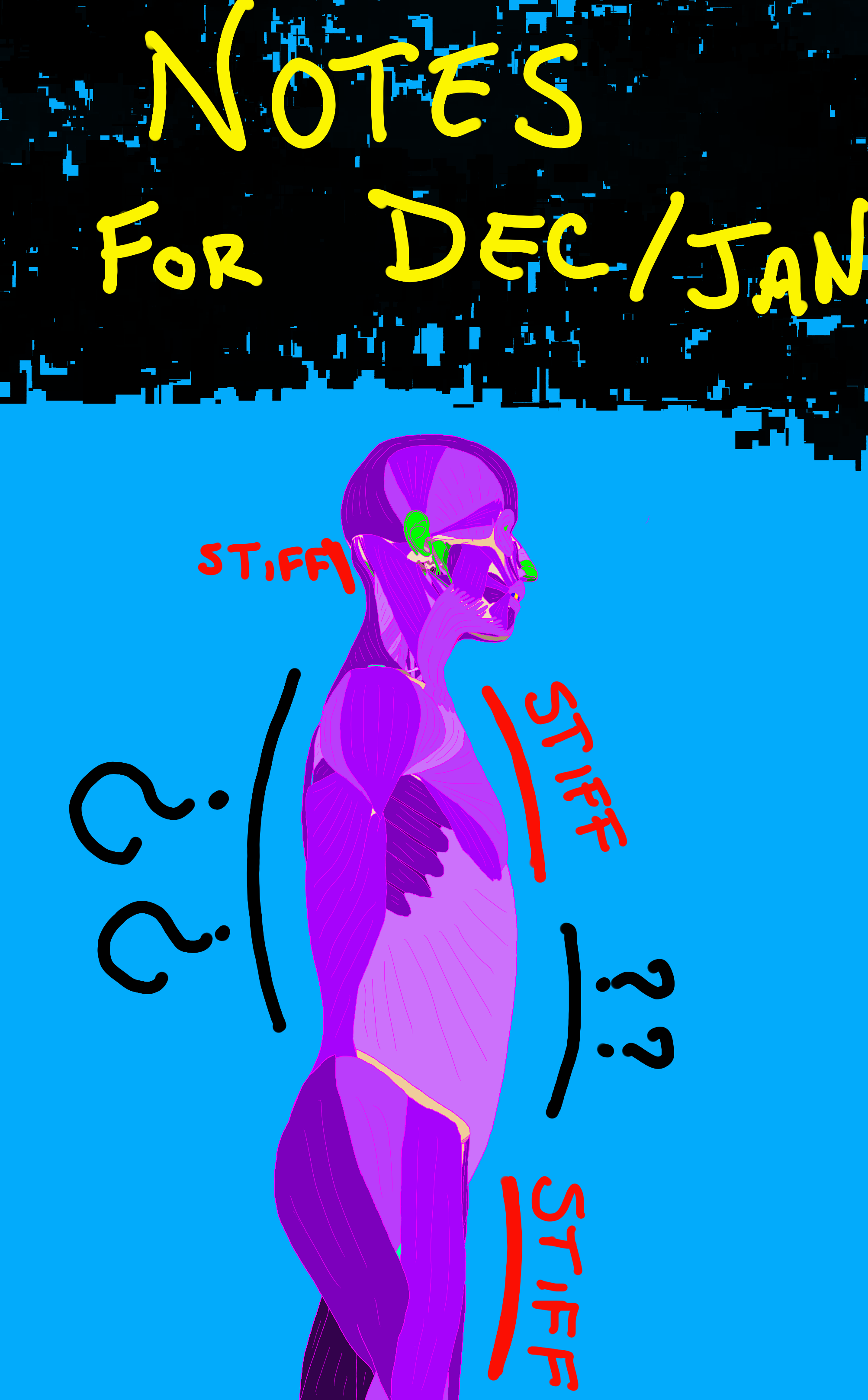
In the image above, I’ve highlighted things in red and black. The red areas are ones that are absolutely positively stiff zones for you (and many many many people). I’ve highlighted the other bits of the torso with black because I suspect these areas feel lethargic or dead. As you lie down or sit quietly in a comfortable chair1, you can ask yourself the very simple meditative question,
“Can I feel that red zone at the back of my neck?”
“Can I feel that red zone in my chest?”
“What does the whole length of my back feel like?
It’s quite likely that when you’ve thought about your chest muscles you’ve only ever thought about the lower portion near the ribs. If you look at what I’ve highlighted in red, you’ll see that those chest muscles go all the way up to the clavicles. Can you feel the full breadth and depth of that zone?
My hope is that if you do, you will gradually feel the muscles of the pectoralis major melt and spread from the breast bone to the outside of the upper arms. This melting into spread will only really happen if you allow yourself to feel the entirety of the torso to some degree. You want to also imagine the black zones of the back!!!
If this doesn’t happen within a month, don’t sweat it, we can go over it during our next lesson!
Wait!!!! What about my NECKKK!!!!!
Good catch Sasha! The chest cannot lift in isolation; it MUST be related to the tension in your neck. Just as I’ve asked you to feel the entirety of the pectoralis major AND how it relates to the back of your torso, you’ll want to also allow yourself to feel the full breadth and depth of the red zone I’ve drawn in the neck and see how that relates to the rest of your neck.
When in Doubt
Your first job when contemplating ANY of this anatomical stuff is to allow your thoughts to be very quiet, simple, and almost empty. If you feel like you are exerting effort to make something happen just give yourself the simple reminder, “This can theoretically be extremely comfortable.”. All you really have to do is stay out of the way.
Does This Resonate With You?
These blogs are hopefully a way of helping you better understand yourself, how you function, and why things sometimes feel off in a general way. If these posts are helpful, I encourage you to subscribe, leave a comment, ask a question, or check out the archives for my previous articles. I like hearing from everyone and I’ll do my best to respond as I can.
Get In Touch
If you’re in NYC, you may learn more about my private teaching practice at johndalto.com.
If you’d like to book any lesson time with me, you can find my booking link here.
here I’m thinking any chair where you don’t feel like you’re forced to slump or stiffen…movie theater chairs work great for my height for some reason
With this, you translate complex anatomical ideas into something calm and usable, while keeping curiosity and kindness at the centre. This is a tricky thing to do. Another great post.