
Does Typing Posture Impact Your Health?
It's not obvious to everyone that it is!

Happy Monday!
For those of you that don’t live in New York City, let me tell you… this town went NUTS on Saturday night when the Knicks played the Spurs in the NBA Finals. I’m not the biggest basketball fan, but when the hometown team hasn’t won anything for 53 years you kinda feel compelled to check out the scene. And when New York is in the mood, it delivers a real scene!
I went out for a walk expecting to see every bar absolutely packed and of course they were. What I wasn’t ready for was the mass viewing party happening at every single open business. The closest thing I’ve scene to this kind of scene was being in Italy in 2002 during the World Cup where EVERY SINGLE PERSON was out and watching at EVERY RANDOM PLACE.
The fried chicken shop had the game on a big screen tv on the sidewalk. Paolina’s falafel had their lawn chairs on the sidewalk, sound system blaring1, and was packed with folks inside and outside the shop. All of Bedford between Grand and South 2nd St had basically turned into a block party before tip off.
So when the Knick’s actually did the deed, this happened:

To the Bloggssss!
This week I’ll have the pleasure of introducing the Alexander Technique to a group of office workers. I thought I would take the time to share how I will approach the topic. Hopefully it will reinforce some ideas for you or give you a slightly new way of thinking about this whole Alexander Technique business.
So You’d Like to Improve How You Feel?
We all have a lot of things going on in our lives. We have to juggle our limited time between our jobs and families and it leaves us without much time for ourselves. These moments where we get to do something just for us are precious. When we use these moments to enrich our lives we feel more complete - more US - and more capable of doing our jobs with grace and appreciating our families without wanting to pull our hair out and run away to a mountain spa retreat for a month so we can just stare out a window in silence while dreading the ever quickening march towards our inevitable demise.
Some people choose to take this time to start a hobby. They begin painting or learning an instrument. Maybe they take up running, dance, or volunteering. Whatever the choice, the simple act of engaging your imagination and taking the time to improve yourself can have tremendous benefits for your life.
The wonderful thing about this time is that it cannot be a waste if you find it fun and enriching!
Yet something curious happens when we begin to invest in our personal health. Many of us feel the aches and pains of getting older and rather than taking a moment to STOP and ask, “What’s happening to me?”, we dismiss these aches and pains as a normal part of life and press on. Before we know it, discomfort is our normal way of living.
These aches and pains are commonly associated with Desk Life.
It’s not like we don’t TRY and do something to change these aches and pains, it’s that we try to get rid of these discomforts and they just stick to us. In some cases, we’ll go online and find a neck massage device or we’ll lie on a heating pad. Maybe we gone to see a doctor, physical therapist, massage therapist, or chiropractor and try to get help that way. But it’s rare that we find something that gets at the root cause of our aches and gives us tools to alleviate tension and start reliably feeling better.
The Alexander Technique and ME
Before becoming an Alexander Technique teacher, I worked in the corporate world using statistics to solve problems for a technology company; these days, the job is called Data Science. The problems I worked on were fun and engaging, but the hours were quite long and my company could not provide me with a proper chair for budget reasons. As a result, I sat quite low while working.
Even though this period of sitting too low in a chair was “only” 6 months, my arms eventually stopped working. I had pinched a nerve from improper sitting and was unable to type. Oops!
After reporting my injury, the company got the office new chairs and life went on. I found that my hands could work enough to get through a 40 hour work week if I made some lifestyle changes:
Strict 10-6 schedule
Walk when I was uncomfortable
No devices outside of working hours
I went to a doctor and was prescribed some anti-inflammatory pills and told to do PT. I was very reluctant to do physical therapy because I had had a long course of PT to heal from an ACL injury. And while I thought PT was terrific for healing from a specific injury, most of the exercises boiled down to stretching, calisthenics, and weight lifting. This injury felt very different to me.
The thing that I felt was that even though I was using a new and “ergonomic” chair, my body felt like it was stuck in the broken chair. I didn’t want to just throw exercises on top of exercises. I wanted to sit down with someone, talk about how I was sitting and typing and get to the bottom of how things could change for the better.
Eventually, I was told by someone that I should really get to the bottom of this issue and I should seek out help from a specialist physical therapist that exclusively deals with musician injuries or I should study the Alexander Technique2. I was intrigued by idea and reached out to about 10 professionals across both fields. One person returned my call and that was my Alexander Technique teacher, Beret Arcaya3.
My first lesson was a fairly classical Alexander Technique lesson. I stood in front of a mirror and had some seemingly innocuous remarks made about my posture. Beret then placed hands on my head, neck, back, and arms and made almost no adjustments to me. Yet somehow, I could feel years of tension melting away and sensation and range of motion returning to my whole self.
I felt wonderful, but it left me with a few questions:
How was this possible?
How could I have this melting sensation on my own?
Would this sensation carry into my daily life?
and WHY wasn’t everyone talking about how GREAT this all feels?
I had just stumbled my way into a brave new world…
A Novel Approach to Understanding Balance
Let’s return to my favorite picture from Seán Carey’s book:
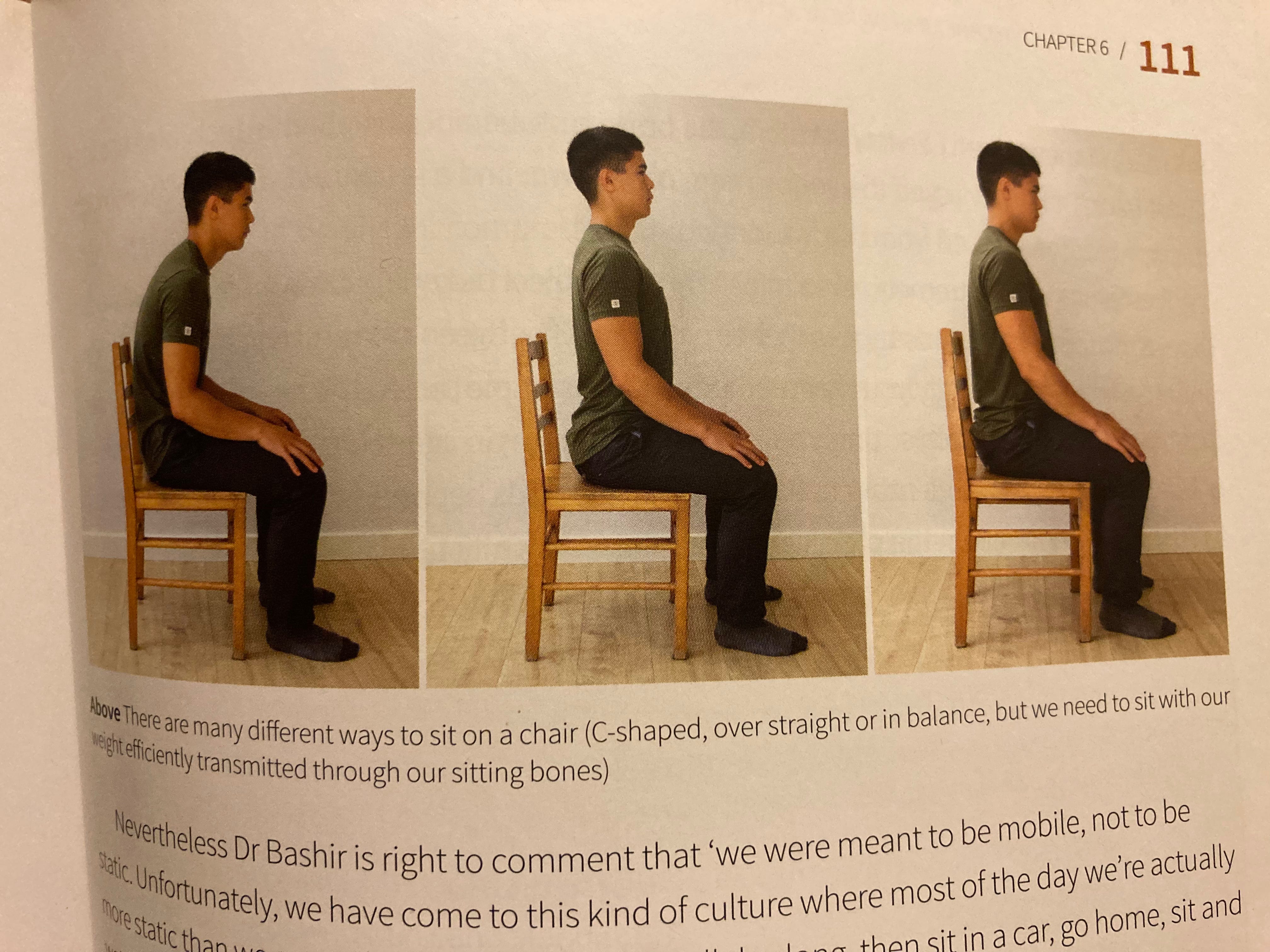
After my injury, I definitely never sat like the man on the right. My back tended to be stuck in the middle position, but boy you’d better believe I knew how to slump like the guy on the left!
As I worked with my Alexander Technique teacher, I was slowly shown how to feel and name how my head, neck, and back were stiff. These conversations were not centered around fixing a position that I was sitting in but were instead centered around the sensation of balance in my head and softness (or lack thereof) in my neck and back. By slowly learning to play a little balancing game with my head while I typed at work, I felt less and less tension during the day and began to feel calmer overall.
These sensations occurred because my head was slowly putting less and less downward pressure onto my spine. This slowly alleviated my back pain and helped take pressure off of the pinched nerve in my neck.
The only “homework” I was given by Beret was to lie down each day for 15-20 minutes. During my regular life, I was asked to notice if things made me stiffen my neck - like drinking from a glass or ordering that coffee in a rushed manner - and then see if I could simply not stiffen my neck when doing those activities. I was asked to turn the normal - seemingly boring - daily tasks into a little game of balance, tension, and release and it slowly helped over time.
Is the Alexander Technique Right for YOU!?
If practicing the Alexander Technique feels fun and good, then the answer is resoundingly YES!
Other folks than find themselves studying the Alexander Technique are:
musicians
actors
office workers
folks looking to improve their confidence in public speaking
therapists of all sorts
teachers
Basically anybody that has to work long hours and mysteriously feels tight or just feels like something is “off”.
Without the hands-on guidance of a teacher, it can be a bit mysterious to figure out how the balance mechanism of the body functions best and it can really be a struggle to work out how tension can release. It’s called the Alexander Technique because there are ways that we can reliably release tension and balance better. But if it’s not something you’ve worked out for yourself, then Alexander Technique “exercises4” with the aid of a teacher can help you identify how tension is being held and how to release it.
If this sounds like YOU, then a lesson is the best way to learn more!
Does This Resonate With You?
These blogs are hopefully a way of helping you better understand yourself, how you function, and why things sometimes feel off in a general way. If these posts are helpful, I encourage you to subscribe, leave a comment, ask a question, or check out the archives for my previous articles. I like hearing from everyone and I’ll do my best to respond as I can.
Get In Touch
If you’re in NYC, you may learn more about my private teaching practice at johndalto.com.
If you’d like to book any lesson time with me, you can find my booking link here.
yes, it’s a falafel shop with audiophile speakers… it’s Brooklyn afterall!
I’m telling you this detail, because great help can come from a variety of professions/specialists and I do not want this story to sound like I am plugging the one and only one way of getting help.
Check your voicemails folks!
These exercises are more akin to musical exercises/technique that you would pick up doing something like Suzuki than exercises like planks and push ups.
Great stuff man!