
Expanding The Thoracic Cage
AKA I'm BACK, BABYYY!!

Happy Saturday!
Have you ever started a project that initially seemed super simple and then kinda BLEW UP in your face and took way longer than expected? Well… let me tell you… today’s DUMB DRAWING is one of those dastardly culprits. I must have started and restarted this drawing 3 times before I got something halfway presentable to share with you. So I do apologies for the hiatus but we’re officially BACK into the swing of things.
So without further ado…
To the Blogsss
Let the neck be free
So that the head may balance forward and up
So that the spine may lengthen and the torso arrive at its full volume
So that the knees are forward and away from the pelvis…
Let the neck be free
So that the head may balance forward and up
So that the spine may lengthen and the torso arrive at its full volume
So that the shoulders may be apart from one another
So that the wrist and elbows may free
I’ve been writing little posts these past few months to help expand on the meaning of Alexander’s directions1. Memorizing the words is important. From the memorization, we want to quietly have a growing sense of feeling that follows the words. These thoughts may at first be experienced as a “body scan” but ultimately we are choosing to engage the kinesthetic sense while we live. This kinesthetic choice is akin to choosing to listen to others when you walk into a meeting or a class.
If we can choose to listen, we can choose to feel and balance.
Enter the Cage
Below the head and neck is the thoracic cage of the ribs, thoracic spine, sternum, and clavicles. Check out the drawing below that took an unexpectedly long time to make!
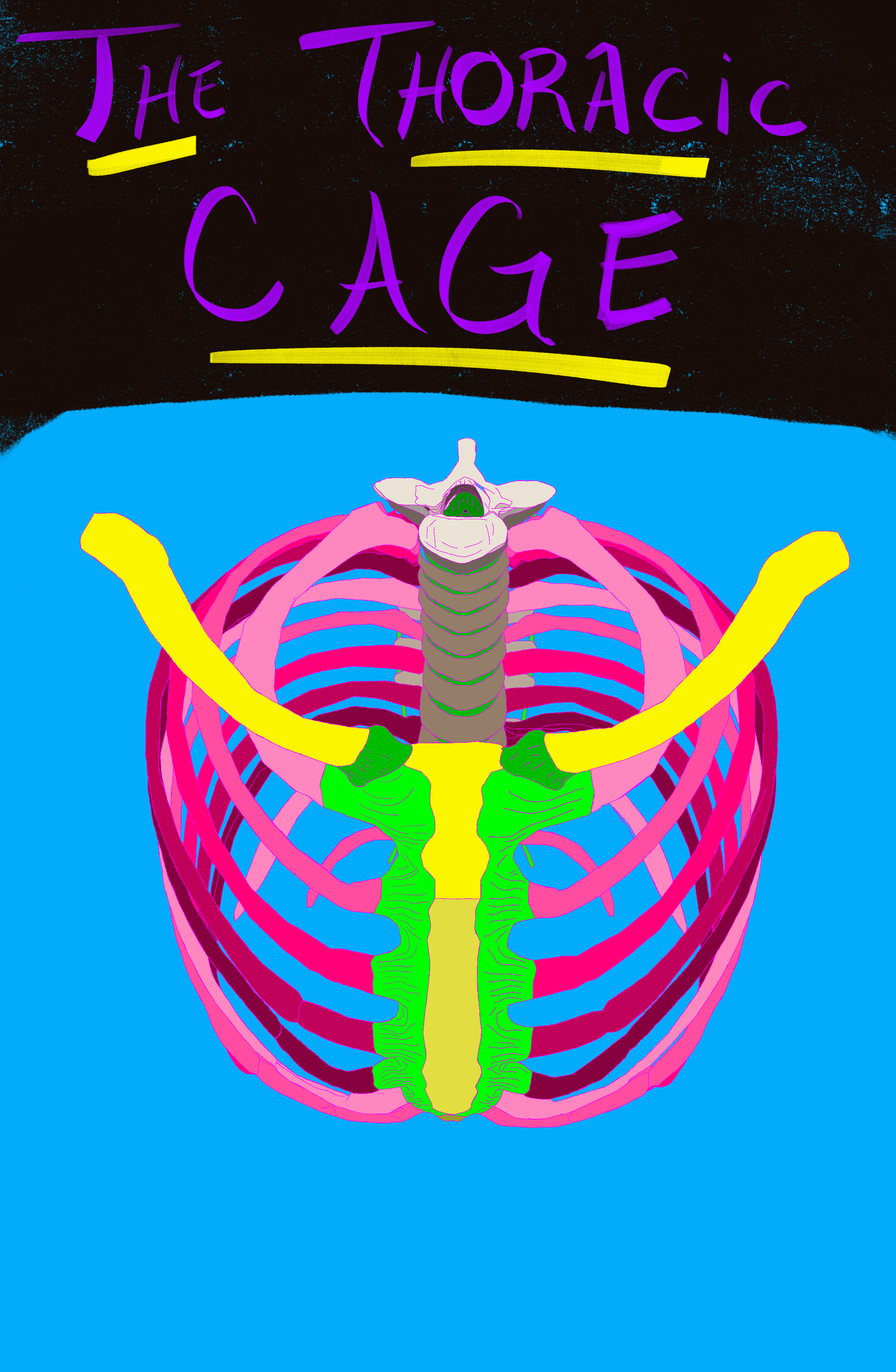
I’ve colored the spine in grey, the sternum and clavicles in yellow, and the ribs in shades of red. I’d like you to take note of a few things here:
The innermost circular portion of the spine is where our weight should load. The three-pronged grey shape is the part of the vertebra used for back muscle attachments.
The ribs join to the spine, wrap around, and attach to the breast bone.
The location of the rib joint may be deeper into the back than you expect.
When things go awry…
When we have tension in the upper back, we can lose mobility in our ribs. Typically, I experience this as a locking of the thoracic spine and a heaviness along the front of the top 2-3 ribs. It’s almost as if the helicopter of the head is crash landing onto the neck and creating a depression in these upper ribs.
If this is you, I would call that a slump!
For many folks, this slump does not happen along the midline. In addition to the downward force of a heavy head, we can also crash land our helicopter in a corkscrew type of manner. This spiralling crash land can flow through the ribs in unexpected ways.
For some folks, the sternum will feel stuck pointing off to the right… Almost like they’ve spent all day sitting with a computer monitor off to the right or they play an instrument like the saxophone… This off center twist should be detected!
If you suspect your sternum is stuck off center, you can lie on your back and ask yourself if you feel even contact with the ground where the ribs attach to the spine (roughly 2-3 inches along either side of the spine). Slight differences in pressure between the left and right are a good clue that you have twist in there! Notice this and don’t bully yourself into a forced midline shape2.
For other folks, they may have individual ribs that are twisted out of alignment. I typically check for this on others by feeling along the front or sides of the rib cage (particularly the top 2-3). You can generally find some very slight differences in height between the right and left sides that are not related to the whole rib cage turning left of right. Gentle manual manipulation at these points can typically be felt all the way along the rib and into the spine. It can feel quite good to have these locked ribs moved and the act of feeling these ribs free up gives the person a visceral experience of soft/expanding volume in the torso.
These discoveries can be made on your own over time. If FM Alexander could do it, anyone can!
Does This Resonate With You?
These blogs are hopefully a way of helping you better understand yourself, how you function, and why things sometimes feel off in a general way. If these posts are helpful, I encourage you to subscribe, leave a comment, ask a question, or check out the archives for my previous articles. I like hearing from everyone and I’ll do my best to respond as I can.
Get In Touch
If you’re in NYC, you may learn more about my private teaching practice at johndalto.com.
If you’d like to book any lesson time with me, you can find my booking link here.
A note on the wrist and elbows… I’ve heard the phrase “allow a pull at the elbows” used to describe the articulation of the arms. I like this phrase but without hands-on instruction it reads like there should be force placed into the arms.
But it would be lovely if things thawed into the midline…
“So that the knees are forward and away from the pelvis…”
I’ll get there someday soon …
This really helps with something I am working on in my Wing Chun classes. Just brilliant.