

Last week, I told myself that I did not need a space heater. I looked at the weather forecast and thought, “yeah, we’re almost out of the woods…”, and cancelled my Amazon order. As I sit here typing away on a cold Saturday night, I’m wondering things like:
What was so wrong about having a space heater?
Why are you a masochist?
Is Jeff Bezos the problem, or YOU, John?!?
**Bezos is always the problem…
So pardon this week’s post if it’s a bit short! I need to get my hands back into my pockets while I make a hot whiskey!1
Breadth and Depth
Allow the neck to be free,
So that the head balances forward and up,
So that the spine lengthens and the back expands to its full volume…
The above is a brief reminder of the beginning of the directions in the Alexander Technique. These are not words that you are supposed to say in your head, but rather a kinesthetic guide towards release. With practice and patience, you will find that you can allow the thoughts above, feel a reaction taking place, and slowly change how you carry your own weight2.
But what happens if you can’t actually sense your head, your neck, or your spine? How can you begin to kinesthetically feel something that you’ve never thought about before? If I ask you to feel the whole column of your spine as you sit here and read this sentence, can you actually do it?
For most people, the answer is neither a perfectly resounding YES or NO. When I quiz my students, they normally respond that they have a sense of the spine in their neck and near the lower back/pelvis but that everything in between is a bit of a foggy unknown. This is an honest starting point, but if it’s at all possible we would like to be able to lift the fog and feel more of the spine.
Because if you can’t feel it3, it won’t move.
One thing that might help you better feel your spine is to look at an MRI!
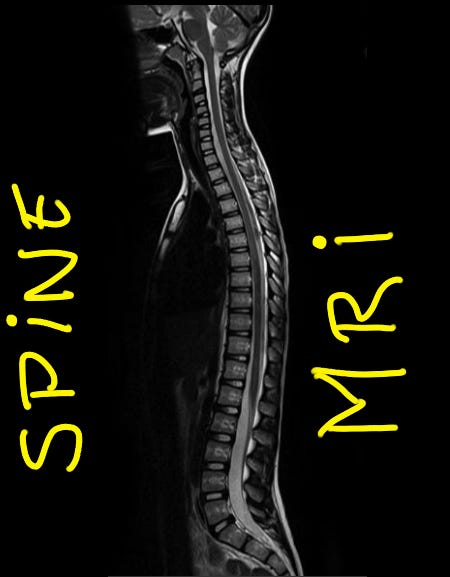
This is an image taken from the midline of a person. I’ve left this image fairly unmarked so that you can refer back to it and check out whatever you like without my marks getting in the way. Most folks don’t know what they’re looking at, so I’m including a little legend below:
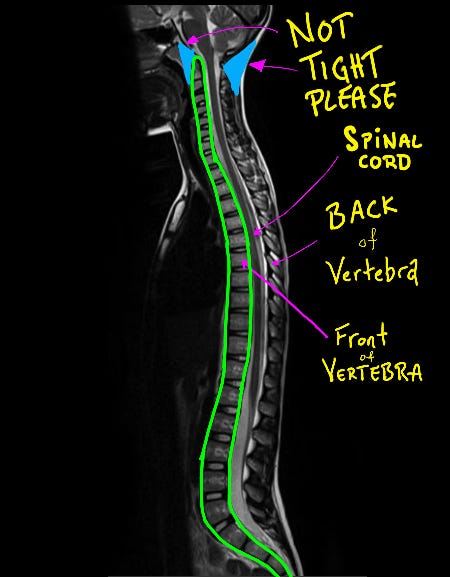
At the back of the person, you will see a tiny pink arrow pointing to the back of a vertebra. In front of that, you will see the spinal cord (you can trace that grey channel down from the brain. And in front of that, you will see the front portion of the same vertebra.
So basically, you’re looking at each vertebra as if it has been cut in half.
The front and back of each vertebra is bone. The front portion is a solid cylindrical shape that is designed for supporting weight. Along the front of the spine there are ligaments that help support the structure.
The back portion of the spine has pointy prongs for muscle attachments and is where a lot of the spine is held together. These muscles help us stay upright and move in all sorts of ways.
The Blue Zones
At the top of the spine, you will see that the front of the spine begins to curve back and up away. In front of this curve, I have highlighted a light blue zone at the back of the throat. This is not a bone, it’s flesh, and when we feel tight this blue zone feels like concrete. It would be very nice for this front blue zone inside your mouth to feel lively and resonant.
At the base of the skull towards the back I have highlighted another blue zone. This is a big bad of muscle that we would like to be free of tension. When the weight of the skull fails to balance on top of the neck, these two blue zones freeze and the neck locks. Yikes!
Ideally, our weight should flow through the highlighted green portion of the torso. Take a minute and check out how deep the spine is within YOU!
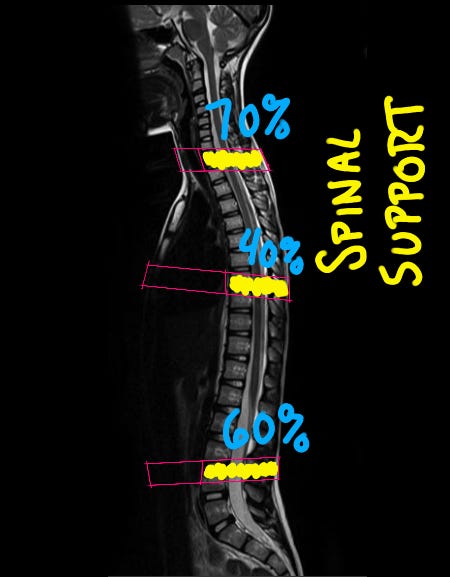
In the image above, I have drawn some red cross sections from front to back. Notice at the neck how HUGE the spine is. I’ve labeled it as 70% of the depth of the neck, 40% of the depth of the ribcage, and 60% of the lower back4. That’s a pretty fast and lose eyeball estimate. I do not want you walking around calculating percentages in your head.
Percentages Matter
When we habitually hold tension in our head, neck, and back, our muscles brace and weight begins to load onto places other than the dead center of the front of the vertebra. Typically, this weight starts loading onto the back portion of the front of the vertebra. As our backs get tighter and tighter, they begin to feel thinner and thinner.
Oftentimes after I show this image to a student, they take a minute and say something like, “Oh yeah, when I think of my spine I only really feel the back portion of the vertebrae. I had no idea how deep things went.”. I think this is a critical realisation and can dramatically help a student better feel what their back actually is.
My ask for you during your next lie down is to take a little time and imagine this depth. See if you can feel the whole depth of the spinal column. Make sure you don’t think that the spine is as wide as your whole back or you’ll find the ribcage gets locked. You want to imagine the full depth of the spine where the spine actually is as inaccurate anatomical mental images will create stiffening5.
Get In Touch
If you’re in NYC, you may learn more about my private teaching practice at johndalto.com.
If you’d like to book any lesson time with me, you can find my booking link here.
Lately I’ve been throwing pepper, cardamon, cinnamon, all spice, and cloves in there with a little honey. Leave a spice mix in the comments and I’ll try it!!!
Some folks would call this posture work, but the Alexander Technique only address posture in an indirect manner.
insert whatever body part you like here!
Unless I eat forever…. then that percentage will decrease….a lot…
You can imagine a dinosaur flying in the air and you won’t stiffen up. Imagination is perfectly fine in life! But if you imagine that you only have one neck bone, you’re probably going to start to feel stiff and heavy.
It's all about smoothening out those little triangles.