
How Do I Fix My Posture?
AKA How one particular Alexander Technique teacher chooses to answer a BIG question...

It’s another belated blogs for you this week. I do apologize as I’m slightly behind schedule. I’ve been caught up with wedding related emails…and boy do these events sneak up on you!
To the Bloggsss!
One of the most frequently asked questions I’ll see on the internet is “How do I fix my posture?”. There’s a whole host of folks out there that feel like they have fallen into the trap of slumping while working and they want OUT. They’ve tried sitting upright. They’ve tried doing some stretches and exercises. But somehow, something feels off and they want this posture problem SORTED.
Recently, a gentleman on the internet asked me if I could tell him figure out what’s going on with his posture and help him get to the bottom of this problem. It might seem odd that I haven’t written a post on postural assessment before, but this is partially because the Alexander Technique addresses postural issues indirectly and partially because most people who find the Alexander Technique don’t ask the question, “How do I fix my posture?”; they instead ask, “How can I feel better?”.
This might seem like an odd distinction. Afterall, isn’t posture somehow related to how we feel? But I think it’s a critical distinction to make because people looking to fix their posture are typically looking to make an exercise program NOW whereas people asking, “how can I feel better”, are more likely to be in a place where they just want to understand why they hurt and if there’s any hope that the pain can change.
By the time someone has walked into my studio, they have typically hit a wall. They’ve tried lots of exercise and massage. They’ve tried yoga, pilates, and physical therapy. And these things just didn’t quite work. We’ll have a little chat about their background, and then I’ll ask them to stand in front of my mirror and tell me what they see.
So for today, let’s use our Gentleman from the Internet’s (GI) photo and pretend that he’s standing before the mirror.
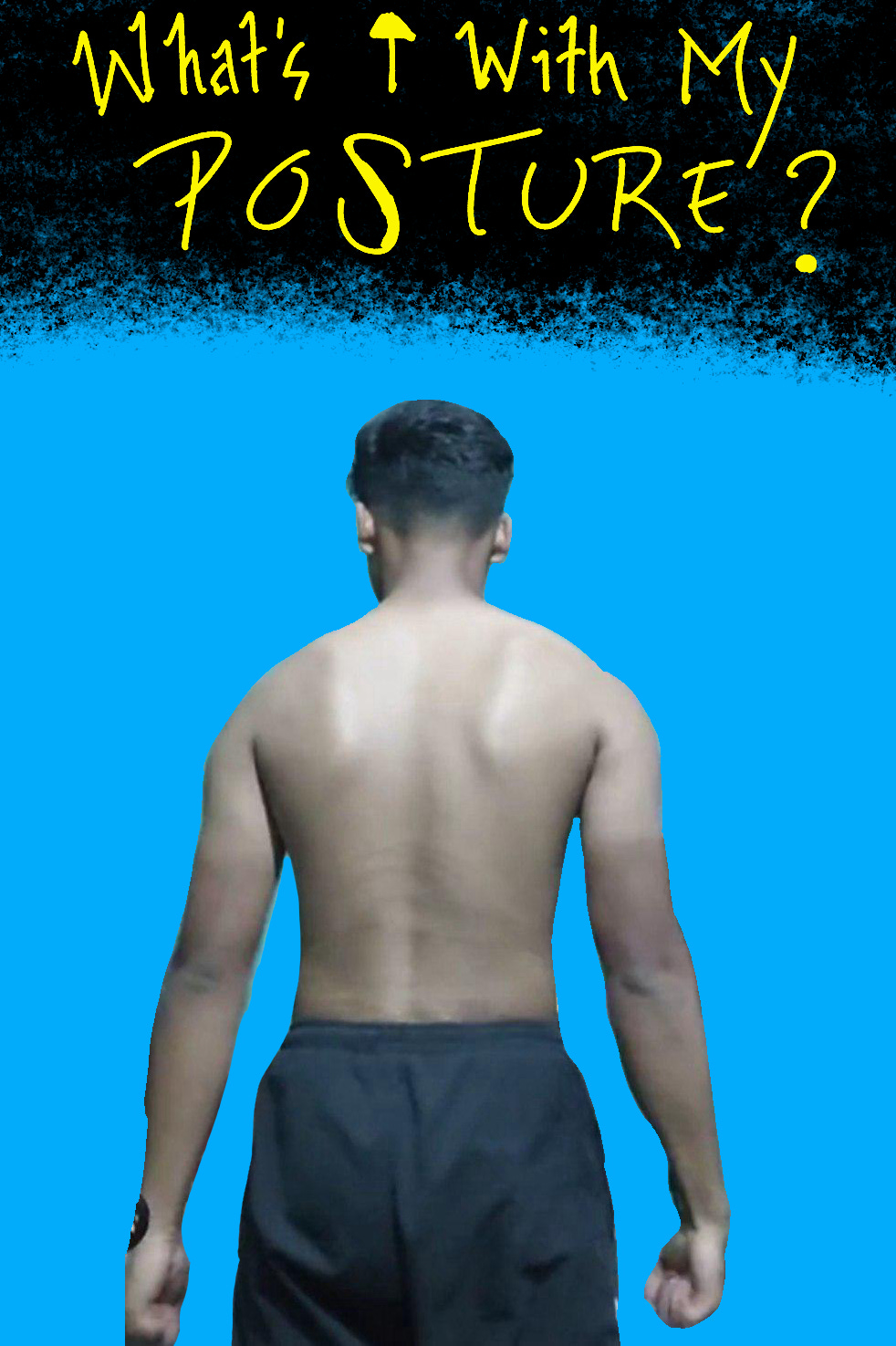
If you’ve never looked at a back before (or front), you might not have ANY idea what you’re looking for. So please, take a minute to look at the photo without looking ahead to my “answers” and see if you can see anything that strikes you as being out of the ordinary. As you look, do bear in mind that this person has done a fairly brave thing and asked for help.
Please have some humility and respect about someone who takes the time to do this.
Still lost? One way you can look at the photo is to look for symmetry. It may be tricky for you to see something asymmetrical around the spine, so take a minute to look at the negative space in the photo. When I look at the negative space, I can see differences in the left and right spaces under the arms and on either side of the neck.
I think something is off balance!
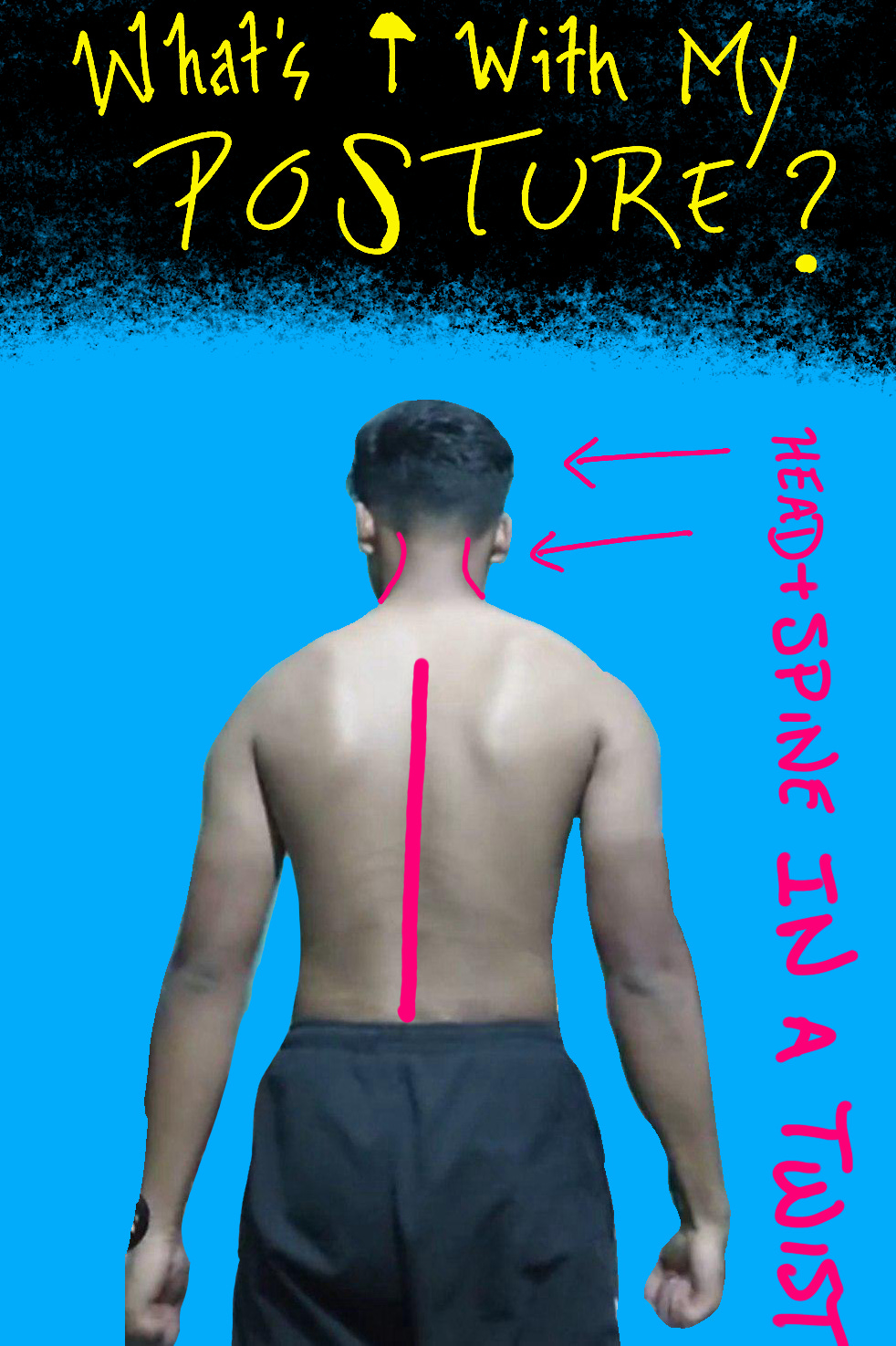
In the photo above, I’ve highlighted the spine and the muscular twist present at the back of the neck. You can go back to the original photo to see a little more clearly. I think that this asymmetry is caused by the head twisting down and to the left (notice how the left ear is more present than the right?).
There is a chance that this asymmetry is caused by the way the camera has been angled and how the person is making a shape to try and get in frame for the photo. With that in mind, please don’t take this assessment as anything resembling a TRUTH. In a real lesson, I have the benefit of making a 3D observation over the course of an hour.
In real life, our postures also change over time so it’s really not a good idea to take any snapshot of a person and say that we definitely know what is happening.
With those caveats in mind, let’s take another view of this back…
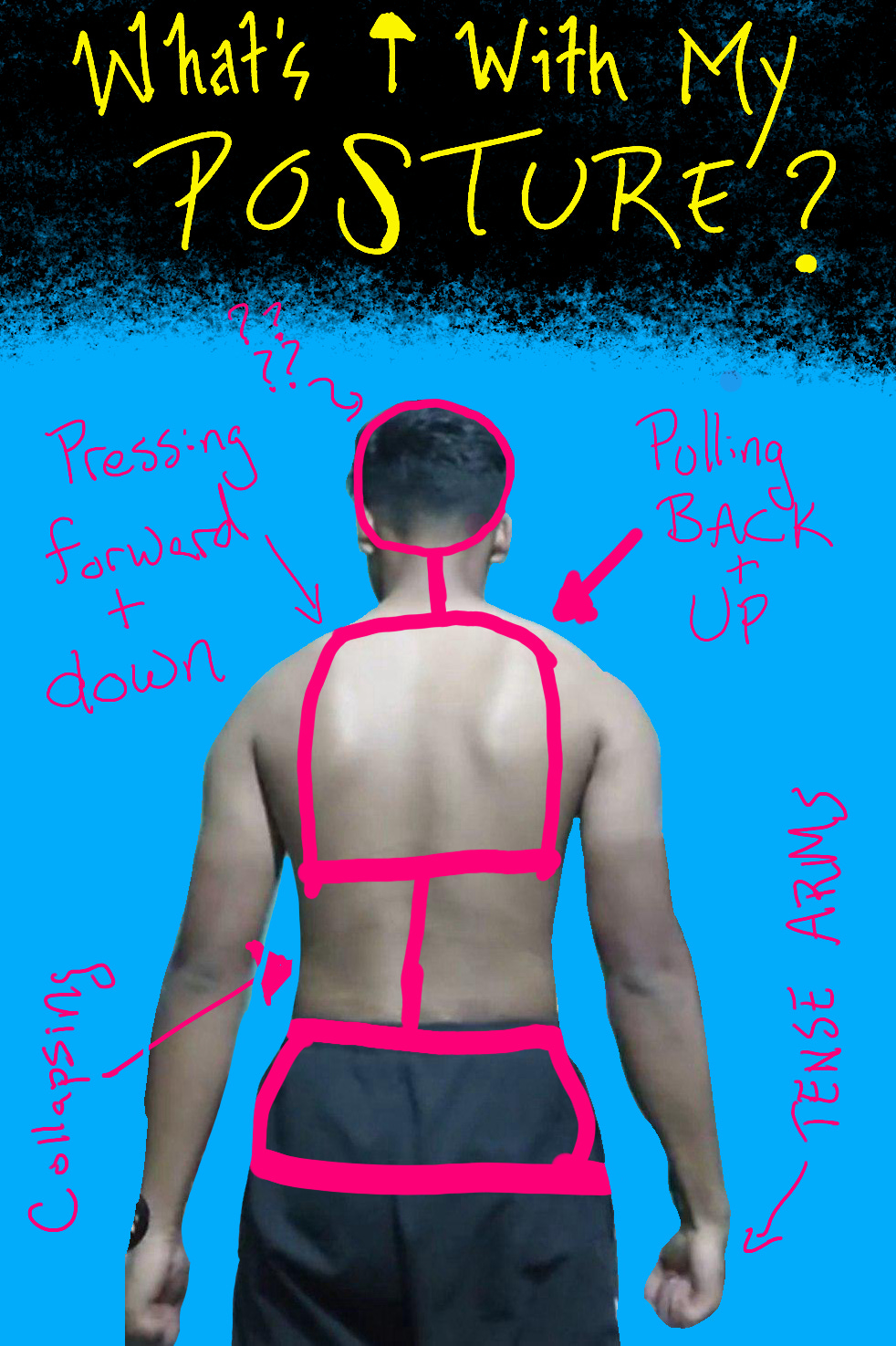
We balance from the head down. As such, I’m going to make the following observations in a top-down manner.
There is a corkscrew action of the head, I think I see the top of the head drifting over the right shoulder and pulling the right shoulder back and up. There appears to be a corresponding lowering and pressing forward of the left shoulder.
Really, the shoulders are drifting in this way because the ribcage is twisted off center. The right upper ribs are pulling back and up and the left upper ribs are pressing forward and down; the shoulders simply follow the ribs. This is a critical distinction to make because many people want to fix their postures by stretch their shoulders.
If you stretch your shoulders but your head neck and ribs stay static, you will never get a real stretch and the shoulders will always fall back to their original place on top of the ribs.
Based on the twist in the head and ribcage, you can see that there is some compression between the left side of the ribs and the left hip. I thiiink I see a little twist in the pelvis as well but this is where an in-person 3D view helps a lot.
Ugghhh So What Do I Do About This?!?
Have some patience! I see a lot of things that are all twisted up in a very unique manner. Every muscle and bone seems to have gotten into a tiny bind and if we just try and push things into a correct shape, we will likely feel the neck stiffen up and the binding around the spine increase. Let’s see if we can avoid that!
There’s Power In Doing Nothing
One of my first posts described how to lie down. It is THE first thing that I ask anyone to do and I’ve written about 6 additional posts on the matter in this series. When we lie down, we have the opportunity to stop holding ourselves upright and allow gravity to give us a passive sense of expansion. From there, you can walk slowly and see if your sense of balance has shifted.
So if you are the GI that submitted today’s photo or if you’re in a similar boat and want to change your posture NOW, I’d kindly ask that you just take a few weeks to try a daily lie down and see if you feel even the tiniest bit of change happen. If you do, take heart! Small daily changes can add up to BIG THINGS over time.
Does This Resonate With You?
These blogs are hopefully a way of helping you better understand yourself, how you function, and why things sometimes feel off in a general way. If these posts are helpful, I encourage you to subscribe, leave a comment, ask a question, or check out the archives for my previous articles. I like hearing from everyone and I’ll do my best to respond as I can.
Get In Touch
If you’re in NYC, you may learn more about my private teaching practice at johndalto.com.
If you’d like to book any lesson time with me, you can find my booking link here.