
How to Lengthen the Spine - Part 3

Allow the neck to be free
So that the head balances forward and up (relative to the top of the spine)
So that the spine may lengthen and the back widen
So that the knees go away from the hips
So that the shoulders rest apart from one another…
Plus the elbows, wrists, hands, ankles, and feet!!!!
I’ve been writing more detailed info on FM Alexander’s directions lately. In last week’s article, I wrote about how you can imagine the musculature of the spine softening and lengthening. It’s an important concept to revisit so do take a minute to look at that before going on to today’s latest and greatest adventure!
What Does Good Alignment Look Like?
Honestly, this is a tricky topic. Good alignment can look like a LOT of things because we’re incredibly mobile creatures. I’ll try and give you a few examples of shapes we can take to illustrate my point. We as HU-MANS (said with an alien accent) can:
Sit and type
Do backbends
Bend over to tie our shoes
Do a triple jump in athletics1
For each one of these things, we can either feel fluid balance throughout our whole self or a crunching compression of crap. For the untrained eye, there is no difference between the look of fluidity and compression outside of the fact that brilliant fluidity in motion and expression will make everyone stop in their tracks, drop their jaw, and applaud unwittingly.
Fluid balance - POISE - comes with a presence of being.
I give you that lecture before showing you the following picture because all too often, people with see an image of alignment and begin to automatically STIFFEN to try and force the position upon themselves. People will react this way without ANY engagement of the kinesthetic sense or any sense of curiosity. This is a pity because the reaction - the impulse to stiffen - happens so fast that we don’t even realise we have done it until it is too late.
With that in mind, I’d like to prepare you for this image by asking that you stop for a moment. Tell yourself that no matter what you see, you will refuse to try and copy the image. Tell yourself that you will refuse to even feel your spine as you look at the image to figure out if you are right or wrong. Let yourself just be curious about the image so that the image and ONLY the image can permeate your imagination.
This preparation is F.M. Alexander’s use of the word inhibition.
Are you ready?
…
…
…
…
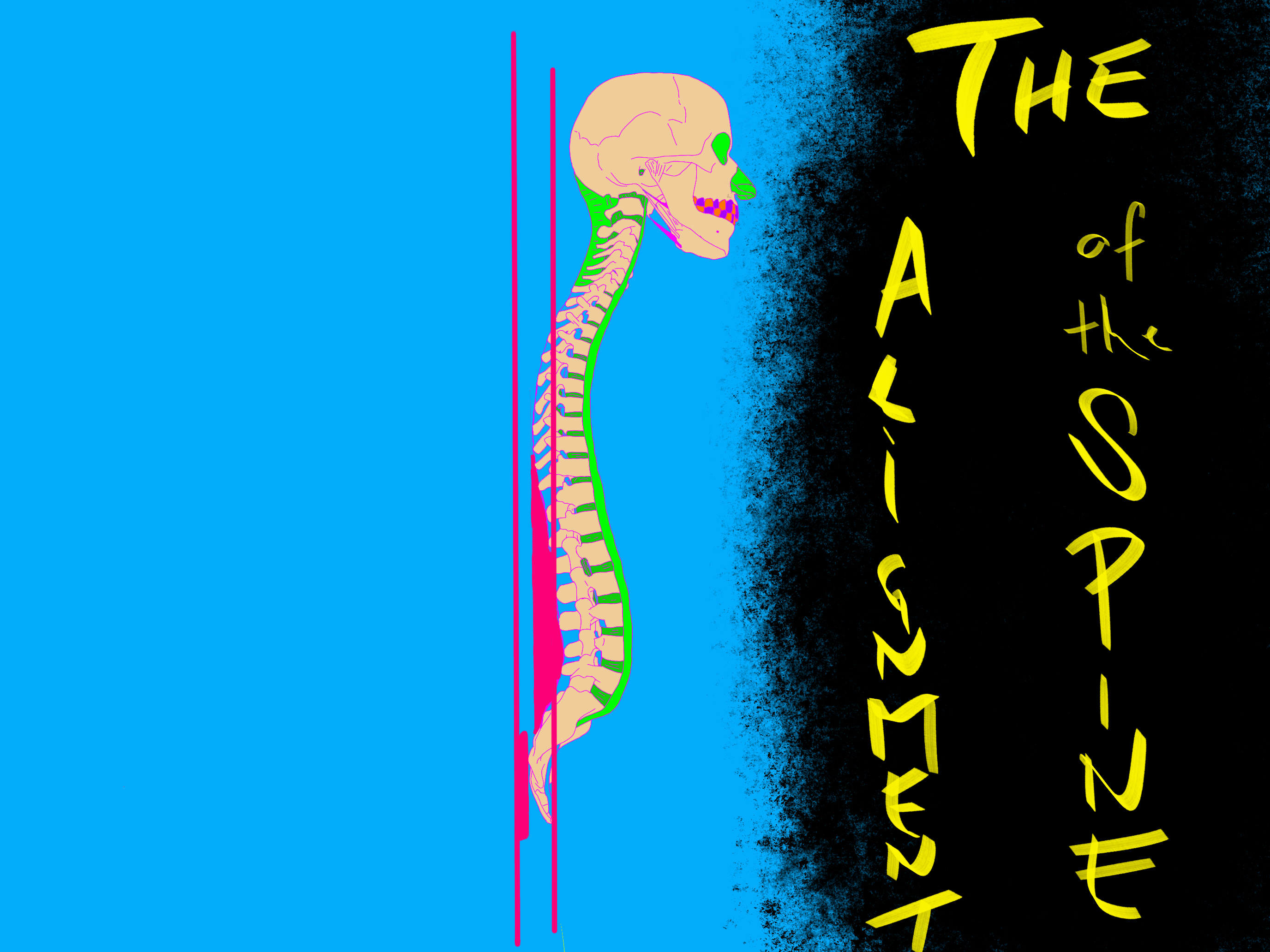
In the image above, I’ve done my best to draw some straight red lines along the back portion of the spine. The image itself comes from my anatomy book and you should bear in mind that the degrees of curvature in the spine vary from person to person. But while the degree of curvature may vary, the relationship between the back of the head, mid back, and tail bone should be oriented along a very delicate forward and up trajectory.
Remember, there are no ribs, shoulders, arms, legs, or muscles present in this drawing. If I were to add all of these in, the torso would fill out and look much more erect than in the drawing above. Here is the same side view with more stuff:
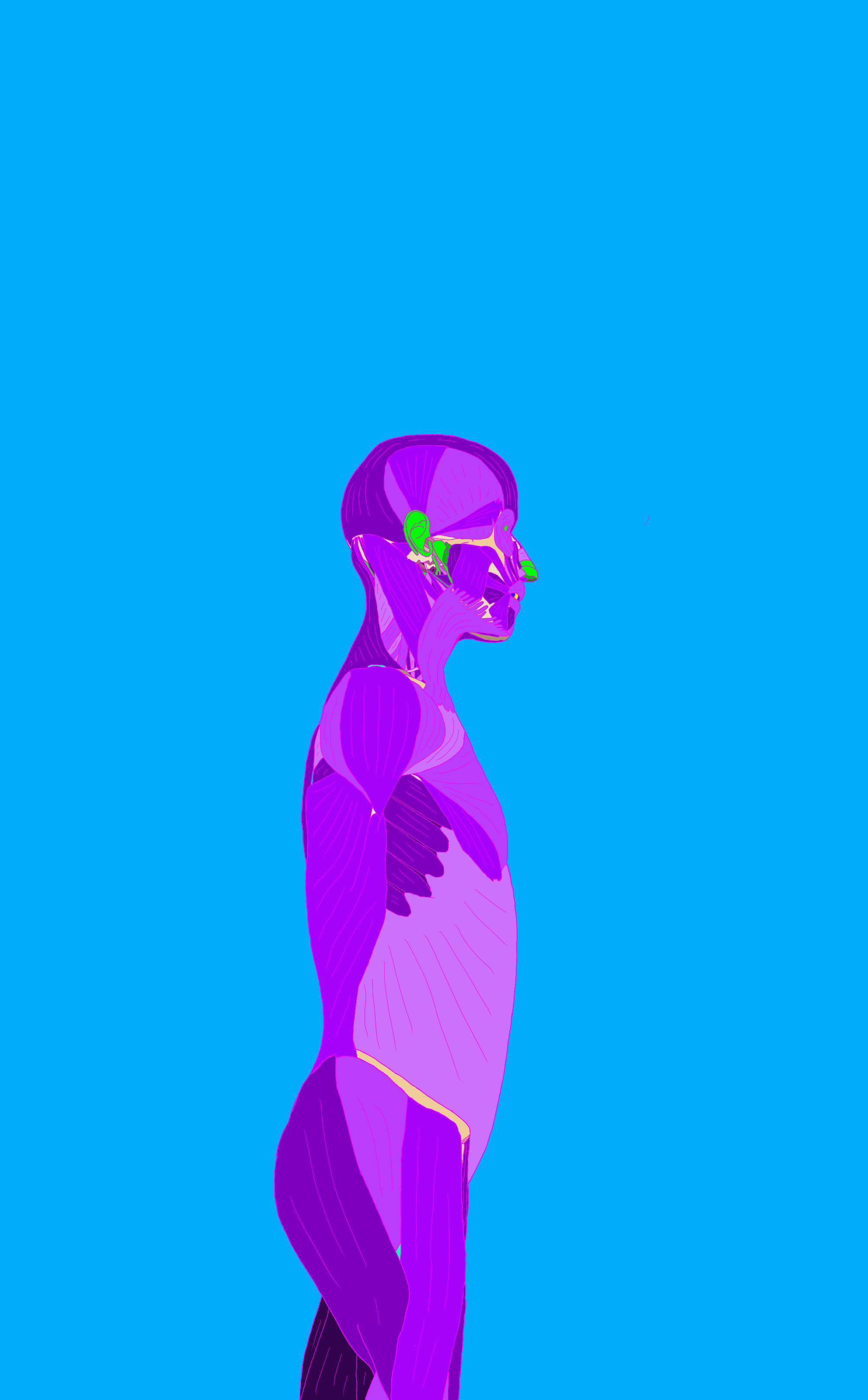
At least to my eye, this looks less slanty with more musculature filled in…
How to Use these Drawings
Most of my students sit and type for extended periods of time. As we get tired, we find ways of stiffening or collapsing to compensate for fatigue. This typically comes with the head dropping down on top of the spine and either pressing too far backward or forward. I can’t really say that one of these compensations is more prevalent than others because once fatigue hits, we start to oscillate between the two or just totally collapse into dead weight.
Assuming that you have a moderately soft neck, we can use these drawings to help better understand how the mid back and hips can align while sitting.
Hips and Rib Cage
When we talk about the alignment of the torso in sitting, we have to talk about the alignment of the hips AND the alignment of the ribs. If the head, ribs, and hips come into better alignment, we will feel pressure coming off of the spine, weight loading into the front portion of the spine, and muscular tension release globally. If you’re trying these experiments on your own and you don’t feel anything changing, BLAME ME AND MY ARTICLES and/or BE PATIENT AND SLOW DOWN2. There’s just something that hasn’t come across yet and an in person demonstration typically helps clear things up.
As I describe the following experiments, remember to feel the balance of your head continuously (or at least semi-continuously). If you forget, everything will feel like concrete.
Do the Wrong Thing
If you sit with a good upright chair, you can align the back of the hips with the chair back. This can serve as a helpful reference point because we absolutely do not want to feel our mid back pressing back into the chair with force. We also do not want to feel our lumbar pressing backwards into a vertical chair.
A very rounded back will have the hips touching the chair back with a little force, the lumbar pressing a bit backward into the chair, and the rib cage slumped forward.
A collapsed lumbar will have the hips touching the chair back with a little force, the lumbar pressing a bit backward into the chair, and the rib cage hoisted upright and pressing into the chair back. Many people would think this type of back is sitting upright, but it is being accomplished with a lot of heaviness.
An arching back will have only a small portion of the hip touching the chair back, a large lumbar gap as the lower back is pressed too far forward and a very rigid rib cage with may or may not be pressing into the chair back.
Typically, I will ask my students to sit in a chair and knowingly press their backs into these various shapes so that they can feel how their necks stiffen up. I have them do this in front of a mirror and with a mirror in profile so that they can see and feel what is happening. We go through these iterations slowly and without jerking the back about so that we have the time to feel changes and not injure ourselves.
This would not be a recommended exercise is you have nerve pain in the spine!
When Things Go Well
When none of these extreme things are happening in the chair, you will feel weight begin to load along the front of the spine. It will feel like the head and the rib cage are floating above the hips and that the tailbone is free of tension. Weight will be evenly distributed on the sitting bones AND you’ll feel like you can gently move.
I do not expect things to feel smashingly awesome as we haven’t talked about the widening of the ribs, the knees, or the softening around the shoulder girdle. So bear that in mind if things still feel mighty stuck on you!!!
Does This Resonate With You?
These blogs are hopefully a way of helping you better understand yourself, how you function, and why things sometimes feel off in a general way. If these posts are helpful, I encourage you to subscribe, leave a comment, ask a question, or check out the archives for my previous articles. I like hearing from everyone and I’ll do my best to respond as I can.
Get In Touch
If you’re in NYC, you may learn more about my private teaching practice at johndalto.com.
If you’d like to book any lesson time with me, you can find my booking link here.
Honestly, the triple jump has got to be the weirdest athletic event to watch next to pole vaulting. WHAT IS THE PRACTICAL PURPOSE OF POLE VAULTING??!!??
It can take a full minute of stopping to notice ANYTHING softening and changing within yourself. If you’re not slowing down, nothing will actually happen.