
How to... Relax on the Couch?
How on earth could such a topic even be worthy of a blog post?!?!?! Seriously...are we about to read the most insane thing EVER?

It’s been another busy week of teaching (I’m not complaining!). Folks are gearing up for their summer holidays and I’m going through the great debate of how much of the World Cup tournament to follow. I basically tell myself that I shouldn’t follow the matches because FIFA is corrupt and full of bribe taking monsters but then I cave on the day the tournament starts up and watch everything.
We’ll see what happens!
Relaxin’ with Lee
In the spirit of all of the SPORTS that can be viewed lately (NYC has gone Knicks crazy in a way I’ve never witnessed), I thought I’d share some thoughts on sitting on the couch.
Sitting on the couch for prolonged periods of time can absolutely lead folks to collapsing in the back and crunching their necks up something fierce. This doesn’t mean that we should burn our couches, but it does mean that we should take the time to listen to what our head, neck, backs are telling us. If they’re saying, “please do something different as I’m a bit uncomfortable with all of this slouched doom-scrolling!”, then maybe we should change how we do all of that!
One of my personal pet peeves is watching folks work for long hours on their laptops while sitting on the couch. I personally don’t see how someone can sit, type, look at such a low screen, AND keep their sense of balance flowing. It seems like the only option is for that person to stiffen up something fierce.
But this doesn’t mean that you can’t sit very comfortably on a couch! In fact, it can be a terrific way to get a little rest and even experience some passive neck length. I’ll do my best to describe what I mean, but bear in mind that every couch is designed differently and some couches are just inherently uncomfortable by design.
Uncomfortable Couch Features
Ultra deep seat
Very low seat
Cushions that swallow you whole
Those are my personal hates in a couch because it can be very difficult to get out of them without stiffening your back! Assuming that’s not happening, let’s go over a little couch constructive rest description.
Couch Constructive Rest
A couch can be a useful tool for helping the middle back to release in the event that a person has a tendency to arch the back habitually. Some of my students have tendency to arch the middle back in standing and collapse the middle back in sitting. If you’re not sure what your tendency is, it can be helpful to sit on a stool with a mirror to the side of you. You can look at your profile in the mirror (no need to tense your neck to do this!) and have a check. Maybe one of these images is you!
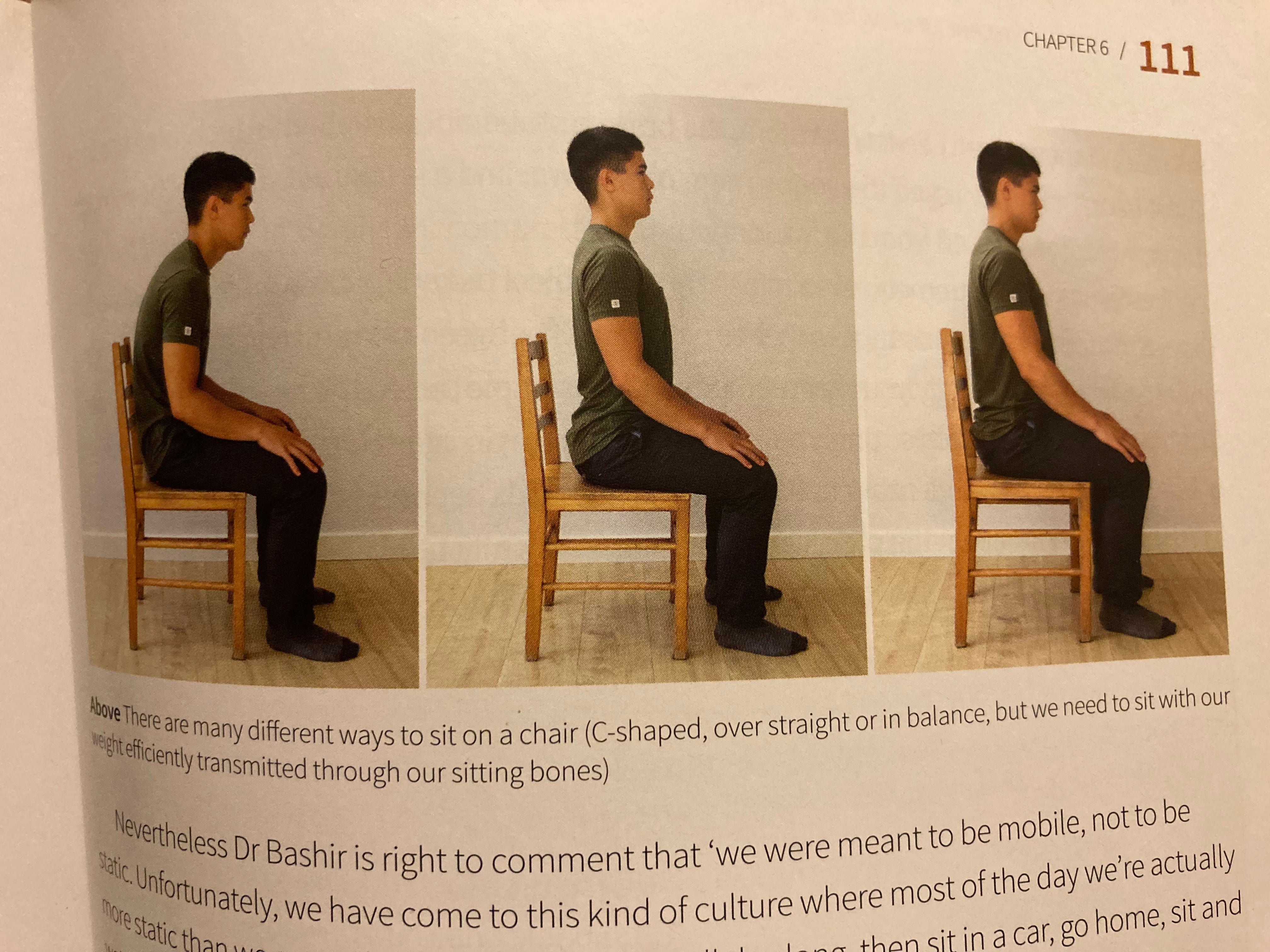
If you tend to sit like the middle picture above, then the couch can help this tension ease.
If you tend to sit like the left picture, then you might feel more comfortable with a cushion on the lower back to prevent a full collapse.
When in doubt, if you feel supported by the chair or couch and not collapsed or stiffened, you have a good setup to begin constructive rest in a chair/couch.
Arranging the Arms
Ideally, we would like the arms to feel light and free of tension. After a long day of working, our arms can build up excess tension and feel very heavy/stiff/tired. You can help the arms release tension by creating a pillow fort so that the forearms are supported by your sides.
Everyone will have a pillow height particular to them, but a good rule of thumb is to have the hands level with the elbows (ish). There really are lots of options here when it comes to the height. The absolute main objective is that we don’t want the pillows giving us the feeling that the shoulders are being forced down1.
Let the Middle Back Rest on the Couch Back
If the pelvis is towards the back of the couch seat (but not shoved into the crevice), you should be able to sit on the couch and sense the middle back having a bit of a rest. Ideally, it should feel like your back is in a slight hammock shape. If this part of the process seems obvious to you, I’ve seen some folks sit towards the front of the cushions and keep their backs off of the couch. This won’t give you the type of rest I’m talking about!
Allow the Head to Tip Back
This step must be done carefully. Depending upon the height of your couch back, your height, and your bum placement, you should be able to have a soft back and allow the head to tip back so that your head is resting on the top of the couch back and you are looking up. If this is done correctly, you will not feel any tension build in the neck nor will you feel a big stretch; you’ll just feel like you are gently looking up.
If this is done in a particular manner, you will sense the skull slide backwards on top of the atlas. I animated this in my older post: How to Pitch the Head. The idea behind constructive rest on the couch is that you can use the couch to support the head and allow yourself the time and space to feel the rectus capitii release (muscles between the skull and the neck). These muscles will only release if you are feeling the hat line of the skull (dashed line in the animation on my older post) in a balanced trust fall on the top of the couch back.
Long story short: Sit on a couch. Let the back be on the couch back. Slowly let your head tilt back and rest looking up.
Caution: Your neck might be sensitive and locked and be unable to look up very far. Do not force your neck to do ANYTHING that it isn’t comfortable doing.
When performed with comfort, you can then allow your whole self to melt into a trust fall. Do nothing, leave every part of you alone, and allow release to find you!
Does This Resonate With You?
These blogs are hopefully a way of helping you better understand yourself, how you function, and why things sometimes feel off in a general way. If these posts are helpful, I encourage you to subscribe, leave a comment, ask a question, or check out the archives for my previous articles. I like hearing from everyone and I’ll do my best to respond as I can.
Get In Touch
If you’re in NYC, you may learn more about my private teaching practice at johndalto.com.
If you’d like to book any lesson time with me, you can find my booking link here.
Don’t try to correct this by forcing the shoulders up. The shoulders should feel like they can hover in their own space.
Been waiting on this one for a long time ... position for falling asleep next!!
Thank you for the tips here. Most couches are not made for shorter than average people do it is hard to sit all the way back, head leaned back looking upwards and all muscles relaxed without the legs sticking straight out. Any suggestions here?