
Lying Down - Part 7
The contact of the hip on the table

Happy Belated Blog! Apologies for the delay, but I’ve gotten slightly sidetracked preparing for this little party. I have a wedding to attend in 2 weeks time and apparently these things require lots of STUFF and THINGS to happen.
And if that sentence is too vague for you, the wedding requires prep on my part because I’m IN the wedding in a rather front and center kind of way… if you know what I mean1…
To the Blogsss
I thought I would share some more comments on how to lie down. So far, I’ve written:
Part 1 - The general idea
Part 2 - The book height and the eye alignment affects neck tension
Part 3 - The spine can freely float between the head and the upper back
Part 4 - The general knee alignment
Part 5 - A prop under the hip can alleviate a locked lower back
Part 6 - Allowing yourself to feel like you’re lying suspended in Jello
These are all details of lying down that I would expect you to slowly learn during a course of lessons.
Before I dive into today’s topic, I want to remind you of some high level thoughts:
Let yourself feel a little bit of everything.
Everywhere and all at once.
No bracing or locking.
No ker-plopping into dead weight.
These invitations/preventions are important to remember so that you don’t just jump into the middle of the technique/directions. My very best lessons (at least that I’ve received) have all come from a teacher assuming that I know nothing. The beginner reminders are important!
With that said, today I’m going to jump ahead and start talking about your HIPS.
The Contact of the Hip When Lying Down
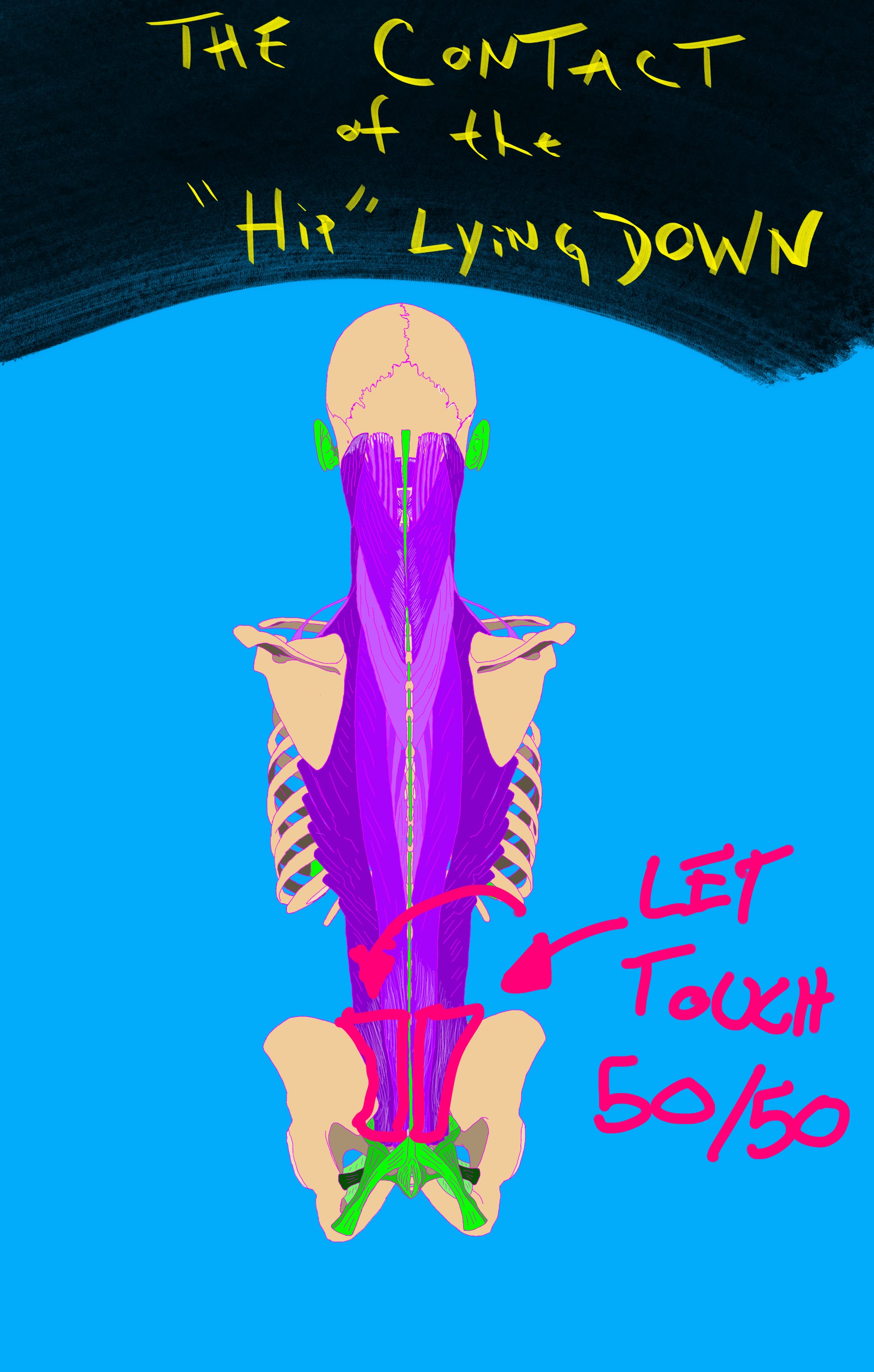
In the photo above, I’ve highlighted two areas in red that should softly melt into the floor when you lie down in semi-supine (AKA the traditional lie down position). Any stiffening in the head, neck, back, or knees can twist the back. The result is that you will feel extra pressure or contact on either the left or right zone.
When I ask a new student to describe how their hips are making contact with the floor, most of them will complain about pain on the outside or front of the hip. They almost never notice that one of these red zones isn’t touching the table at all! I think it’s probably best to give you a more specific example…
Earlier today, I was giving a lesson to a student and I could see that their right pelvis was pressing into the table. As a result, the whole pelvis was twisted a bit and the left side was lifted up and couldn’t make contact. I made a remark on the matter and asked the student if they could also feel the two red zones pictured above. When the student could feel these two red zones and both legs, they were able to all the lower back to release and feel the hips lie much more flush on the table.
I think these two zones are important to sense. For starters, they are an important part of the musculature of the spine. If your neck is only kinda sorta freeing up, allowing a bit of release in these zones could be a big help!
The other big reasons these zones are helpful to tune up to has to do with PAIN.
When we have pain in the hip, it is rarely in these red zones. Typically, I hear complaints about the outside of the pelvis where the femur attaches. After that, I’ll hear folks complain about tension along the front of the pelvis near the groin. Neither one of these is any fun, but both of them tend to come with unnoticed tension in the red zones.
As the red zones release and the pelvis finds more flush contact with the floor, I would hope that you feel even greater release along the whole length of the spine. Your lumbar should still have some curve to it and the length of muscles between the shoulders should start to feel a little softer if you’re sensing bigger and bigger stuff expanding throughout the back!
Does This Resonate With You?
These blogs are hopefully a way of helping you better understand yourself, how you function, and why things sometimes feel off in a general way. If these posts are helpful, I encourage you to subscribe, leave a comment, ask a question, or check out the archives for my previous articles. I like hearing from everyone and I’ll do my best to respond as I can.
Get In Touch
If you’re in NYC, you may learn more about my private teaching practice at johndalto.com.
If you’d like to book any lesson time with me, you can find my booking link here.
And by that I mean I’m getting married!